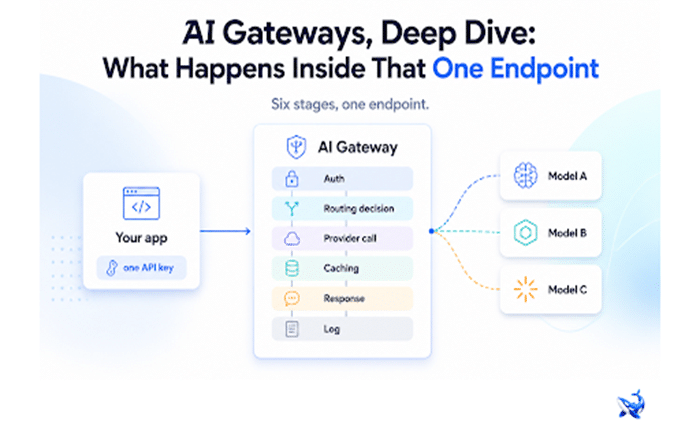
An AI gateway is the one endpoint between your application and every model provider — the place where authentication, routing, policy, caching, observability and failover actually happen. If you’ve ever seen one dismissed as “just a proxy,” this is ai gateway explained from the inside: we walk a single request end-to-end through the six stages of its lifecycle, then unpack the policy, observability and reliability layers wrapped around them — the same view OrcaRouter makes concrete in the request logs, where every request is logged individually, down to the live rate card for GLM-5.3 and what that model costs per million tokens.
The situation that ends with a gateway in your stack is almost always the same. Your app calls one model in production for weeks, everything is fine, and then you add a second model for cost, a third for a specialized task, and “the API” suddenly means three contracts, three keys, three rate limits and a billing spreadsheet you reconcile by hand. Every model you bolt on multiplies the integration surface. A gateway collapses that surface back to one endpoint — and everything it does inside that endpoint is where the real value hides.
The request lifecycle: six stages, one call
Take one request — a chat completion sent from your backend to the gateway’s single OpenAI-compatible endpoint. Between the moment it lands and the moment it’s logged, six things happen, and the order matters.
- Authentication. The API key is checked and the identity behind it resolves to a role with its own permissions. This is where a gateway stops being a dumb relay: one key can be scoped to certain models, certain spend, certain users — or to nothing at all if the call doesn’t carry the right credentials.
- The routing decision. The prompt is graded and assigned to a model. With adaptive routing, the grading happens in under a millisecond, after which the prompt is sent to the cheapest model that still meets your stated standards — or to the exact model you pinned, if you pinned one. This is the stage that separates a gateway from a proxy: a proxy forwards, a gateway decides.
- The provider call. The request is normalized to the target provider’s format and dispatched with the right credentials, usually from a shared key pool that keeps your own vendor keys out of your application.
- Caching. Before the full call goes out, a cache lookup checks whether a shared prefix of the prompt has already been processed, so repeated context — a long system prompt, a big document, a tool-heavy agent loop — isn’t paid for twice. Prompt caching is one of the quietest cost levers in the whole pipeline.
- The response. The output comes back through the same unified format the request arrived in, so your application never rewires itself to match a provider’s quirks. Streaming stays streaming; errors come back in one shape.
- The log. Finally, the request is recorded: which model answered, how many tokens, the latency, and what it cost. On a well-instrumented gateway this isn’t a debug aid — it’s an audit trail.
The policy layer: limits, budgets, roles and guardrails
Between authentication and the provider call sits the layer that decides what a request is allowed to do — before anyone pays for it.
Rate limits are the obvious part: per-key or per-role caps enforced at the gateway, before the request ever reaches a provider, so a misbehaving client can’t blow through a vendor quota (or your budget) in a loop. Budgets take it further. OrcaRouter, for instance, ships budgets and roles on top of its router, so a team key can be capped at a monthly spend and a role can be restricted to certain models — which matters the moment an autonomous agent starts iterating without supervision. Guardrails and an agent firewall sit at the same altitude: they filter tool calls and block the worst failure modes before they become a billing line item. The policy layer is what makes “give the intern a key” a defensible sentence instead of a horror story.
The observability layer: per-request logs and honest cost
The observability layer is where a gateway stops being a black box and becomes an audit trail — and it’s also where the economics either add up or quietly don’t.
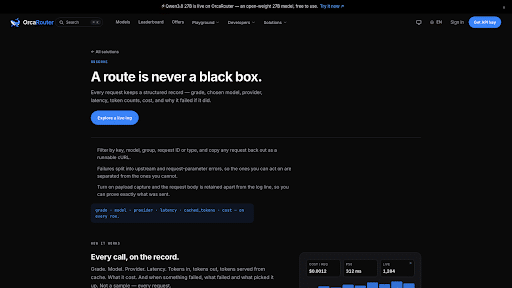
Per-request observability means each call carries its own row: model, tokens, latency, price. That single feature changes how you debug (“which model answered that user, and why”), how you attribute cost to teams, and how you justify a routing change. The price number only means something if it’s honest. OrcaRouter passes provider list prices through at 0% markup — the vendor price with no margin added, receipted per request — so the cost column in the log is the cost you actually pay, not a marked-up estimate. A gateway that logs a fake price is a gateway that lied to you in its most useful table.
The reliability layer: failover, retries and load balancing
Providers fail. They return 500s, they hit their own rate limits, they slow down on a Tuesday afternoon for no reason you can control. The reliability layer is what keeps your application alive when a provider isn’t.
Automatic failover is the flagship move: when the selected provider errors, the gateway retries the request on a fallback model before your user ever sees a failure. That’s the difference between “the API is down” and “that request took a different route.” Retries are the finer-grained version — re-sending the same call with backoff after a transient error instead of surfacing it. Load balancing spreads traffic across models and providers so no single one becomes your bottleneck — and, combined with the routing decision, so the cheap model takes the volume while the expensive one stays in reserve for the requests that need it. OrcaRouter lists adaptive routing, load balancing and automatic failover as first-class features of its router rather than add-ons, which is what a reliability layer is supposed to feel like: present, not bolted on.
The whole stack, in one glance
| Layer | It decides | Skip it and you get |
| Auth | who is calling, with what permissions | a key sitting in a repo, usable by anyone |
| Routing | which model answers each prompt | one model for every job, price be damned |
| Policy | what a request may do and spend | an agent that bills you until someone stops it |
| Caching | what you pay for twice | the same context billed over and over |
| Observability | what actually happened, per request | guessing from a vendor dashboard |
| Reliability | what happens when a provider fails | user-facing 500s on a Tuesday afternoon |
The takeaway
An AI gateway is a software layer, not a vendor subscription: it buys you one endpoint instead of six, honest per-request costs instead of a guessing game, and automatic recovery instead of a pager. Adopt it the moment your second model joins the stack, because the integration surface only grows from there. Don’t adopt one for the dashboard alone — adopt it for the request lifecycle and the layers around it, and verify the observability is real before you trust a single cost number. If you want to see what real per-request observability looks like before you commit, OrcaRouter publishes its request-logs page publicly: one key for 200-plus models, provider prices passed through at 0% markup, and automatic failover built in.
Sourcing note: OrcaRouter product facts — one API key for 200+ models, 0% markup on provider list prices, adaptive routing that grades each prompt in under a millisecond, automatic failover, budgets and roles, and per-request request logs — come from the OrcaRouter homepage and product pages (verified August 22, 2026). The six-stage request lifecycle is the standard architectural framing of AI gateway behavior; no independent benchmark data is cited in this article.