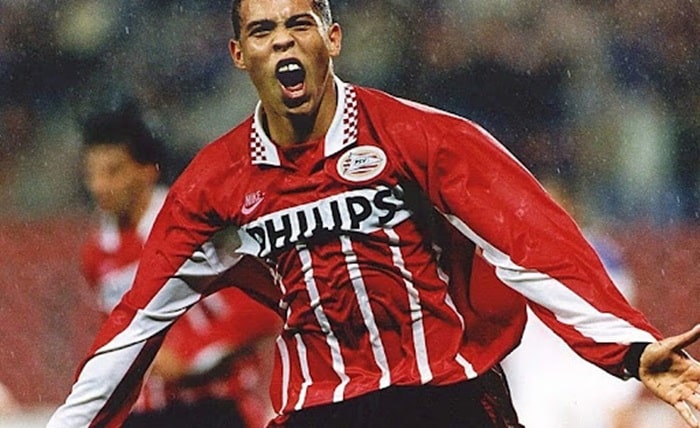
For fans who regularly follow live football, Ronaldo remains one of the names that evokes the strongest emotions. From Cruzeiro to PSV, Barcelona, Inter Milan, Real Madrid, AC Milan, and Corinthians, the Brazilian striker left his mark across different football environments. So, Who Is Ronaldo Nazário? Why is he considered one of the greatest strikers of all time? Let’s explore with 90PhutTV below.
Who Is Ronaldo Nazário?
Ronaldo Nazário’s full name is Ronaldo Luís Nazário de Lima, and he was born on September 22, 1976, in Brazil. He played as a striker and was famously known by the nickname “O Fenômeno”. Real Madrid recorded that Ronaldo made 177 official appearances for the club and scored 104 goals, while also winning two Ballon d’Or awards in 1997 and 2002.
What made Ronaldo special was his combination of speed and strength. He could use his pace to get past defenders, then rely on his technique to beat a second opponent before finishing. His stepovers, high-speed dribbling, and ability to use both feet made Ronaldo a nightmare for many defenses.
Unlike many strikers who excel in only one particular area, Ronaldo could score in a wide variety of situations. He was effective inside the penalty area, from long range, with headers, in one-on-one situations with goalkeepers, and was particularly dangerous on counterattacks. This all-round ability helped him reach world-class status from a very young age.
When exploring Who Is Ronaldo Nazário?, fans cannot overlook his achievements at international level. Ronaldo was a member of the Brazilian teams that won the World Cup in 1994 and 2002. FIFA confirms that he scored 15 goals in 19 World Cup appearances, making him Brazil’s all-time leading World Cup scorer.
Career Journey at Club Level
Ronaldo began attracting attention at Cruzeiro while still very young. His outstanding performances in Brazil quickly brought him to the attention of European clubs. In 1994, PSV Eindhoven signed the young Brazilian striker. During his two seasons in the Netherlands, Ronaldo scored as many as 54 goals in 57 matches according to statistics compiled by Inter Milan.
At PSV, Ronaldo quickly proved that he was not an ordinary young talent. His high scoring rate made him one of the most sought-after young strikers in Europe. Fans following 90p TV can imagine Ronaldo’s style at that time: fast, direct, and always looking to move the ball toward the goal.
Barcelona and His Breakthrough Season
In 1996, Ronaldo moved to Barcelona and spent only one season there, but he made a remarkable impact. According to official data from Barcelona, he scored 47 goals in 51 appearances, winning the Copa del Rey, European Cup Winners’ Cup, and Spanish Super Cup during the 1996/97 season.
This is considered one of Ronaldo’s most impressive individual seasons. He repeatedly produced moments that left spectators amazed, most notably his goal against Compostela, when he carried the ball from his own half, beating several players before finishing.
This was also the period when Ronaldo began to be recognized as a global superstar. Barcelona’s matches at the time became a major focus of 90Phut TV, particularly as the Brazilian striker continued to score iconic goals.
Inter Milan and the O Fenômeno Nickname
In 1997, Ronaldo joined Inter Milan and entered a challenging new chapter. In Serie A, he had to face defensive lines renowned for their tactical discipline and physical strength. However, this did not prevent Ronaldo from producing world-class performances. Inter confirmed that Ronaldo scored 59 goals in 99 appearances for the Nerazzurri and won the UEFA Cup in 1998.
It was at Inter that the nickname “Il Fenomeno” became widely popular. Ronaldo could accelerate suddenly, dribble past defenders, and finish with great accuracy. He virtually became the symbol of the club during the late 1990s.
Those who regularly follow the European football schedule will see that Ronaldo’s Inter Milan was one of the teams that attracted particularly strong interest from fans. However, his career in Italy also marked a difficult period as he repeatedly suffered knee injuries.
Real Madrid and the Galácticos Era
After the 2002 World Cup, Ronaldo moved to Real Madrid. This was one of the most high-profile transfers of the time, as the Spanish giants were building a Galácticos generation filled with superstars.
Ronaldo made an immediate impact on his Santiago Bernabéu debut by scoring against Alavés. According to Real Madrid, his first season at the club ended with the La Liga and Intercontinental Cup titles.
In Madrid, Ronaldo continued to maintain an impressive scoring rate. He scored a total of 104 goals in 177 official appearances for the club. His performances in Spain further cemented his status as one of the best strikers in the world.
This was also a period when fans could frequently see Ronaldo featured in football content updated by 90 Phút TV. From first-time finishes to bursts of acceleration, he consistently brought the ability to make a difference.
AC Milan and Corinthians
After several years at Real Madrid, Ronaldo moved to AC Milan in 2007. However, injuries continued to affect his ability to play. Ronaldo spent a relatively short period at San Siro before returning to Brazil.
In 2009, he joined Corinthians. This was the final stage of Ronaldo’s professional playing career. Here, he still demonstrated his goalscoring ability and helped Corinthians win the Copa do Brasil and Campeonato Paulista in 2009 according to data compiled by Inter.
On February 14, 2011, Ronaldo officially announced his retirement. Real Madrid confirmed that AC Milan and Corinthians were the final two clubs of his career before he said goodbye to professional football.
Fans looking back at those moments through 90m TV can clearly feel a journey filled with glory but also marked by numerous challenges for the Brazilian legend.
Ronaldo Nazário’s Career Journey with the Brazilian National Team
Ronaldo made his Brazil debut in 1994 at just 17 years old. At the 1994 World Cup, he was included in the squad but did not play. Nevertheless, Ronaldo still became a world champion when Brazil won the tournament in the United States. FIFA confirms that he is one of the Brazilian players to have won two World Cup titles, in 1994 and 2002.
The 1998 World Cup in France marked a major step forward for Ronaldo. He scored four goals during the tournament and helped Brazil reach the final. However, Brazil lost 3–0 to the hosts France. Ronaldo experienced health problems before the final and was unable to perform at his best.
Four years later, the story was completely different. The 2002 World Cup in South Korea and Japan became the stage for Ronaldo to make a remarkable comeback after serious injuries. He scored eight goals, won the Golden Boot, and helped Brazil win their fifth World Cup title. FIFA describes this as one of the most impressive comeback stories in World Cup history.
The most memorable moment came in the final against Germany. Ronaldo scored both goals as Brazil won 2–0 and lifted the World Cup trophy. Those two goals became a symbol of his determined recovery journey.
If following bong da truc tiep, fans can clearly see how Ronaldo moved inside the penalty area during the 2002 final. He always chose his position intelligently and needed only one defensive lapse to make the difference.
Ronaldo continued to represent Brazil at the 2006 World Cup. He scored three more goals, including his strike against Ghana that brought his World Cup total to 15. FIFA still recognizes him as Brazil’s all-time leading World Cup scorer with 15 goals in 19 appearances.
With the national team, Ronaldo also won the Copa América in 1997 and 1999, as well as the 1997 Confederations Cup. These achievements helped complete the international trophy collection of one of the most outstanding Brazilian players of his generation.
Brazil matches featuring Ronaldo also became major highlights in the international lịch bóng đá. Encounters at the World Cup, Copa América, and even friendly matches attracted significant attention from fans.
Conclusion
The answer to Who Is Ronaldo Nazário? can be summed up through the image of “O Fenômeno” with extraordinary speed, technique, strength, and goalscoring instincts. More importantly, he was also a symbol of overcoming adversity, particularly through his remarkable performance at the 2002 World Cup. For those who want to revisit classic matches, 90 Phut provides a familiar way to access online football content.